Walk/Bike to School Days
Planning a Walk/Bike to School Day
We can help your school be successful in planning and organizing regular walk to school days, walking school buses and rolling bike trains. Based on National best practices we offer guidance on planning, volunteer recruitment, safety, promotion and more to help ensure success.
March is Mobility Month
With great weather returning, now is a good time to plan walk to school days. Start by downloading the flier template on this page. Then schedule a date with your principal, recruit volunteers and get walking!
You can also download our Walk to School Day Planner or click here for more tips.
February is Heart Healthy Month
February is a great time to share the love of walking to school. In fact, as a valentine gift to your besties, ask them to be your walking buddy!
Download the image to the right, print and color it in. Then share with your walking buddy.
International Walk to School Day: October 12, 2022
Join thousands of schools and millions of kids around the world in this annual celebration of active transportation!
Download the flier to the right or visit walkbiketoschool.com for more resources.
Other Links:
Planning Your WTS Day
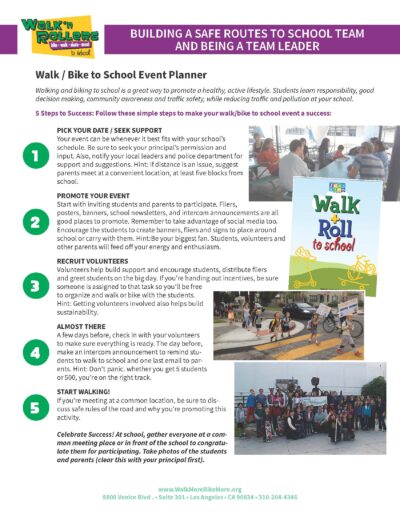
Walk / Bike to School Days: 5 Steps to Success
Getting a Walk/Bike to School Day going is super easy. Remember, the goal is to encourage kids to walk and have fun. To start, don’t get buried in details or the pressure of a huge event. It could be as easy as a few fliers, posters or banners and a welcome table in front of school to celebrate kids’ efforts.
To help you get going, download our 5 Steps to Success flier (click on image at right).
Ready to get started? Follow these simple steps to Success!
- STEP 1: Pick your date. Your event can be whenever it best fits your school’s schedule. Hint: If distance is an issue, suggest to parents they can meet at a remote meetup location, at least five blocks from school.
- Step 2: Get Permission. Be sure to seek your principal’s permission and input. Also, notify your local leaders and police department for support and suggestions.
- STEP 3: Recruit volunteers Volunteers can help encourage students, distribute fliers and greet students on the big day. If you’re handing out incentives, be sure someone is assigned to that task so you’ll be free to organize and walk or bike with the students. Hint: Getting volunteers involved also helps build sustainability.
- STEP 4: Promote your event. Start with inviting students and parents to participate. Fliers, posters, banners, school newsletters, and intercom announcements are all good places to begin. Remember to take advantage of social media too. Encourage the students to create banners, fliers and signs to place around school or carry with them. Hint: Be your biggest fan. Students, volunteers and other parents will feed off your energy and enthusiasm.
- Almost there: A few days before, check in with your volunteers to make sure everything is ready. The day before, make an intercom announcement to remind students to walk to school and one last e-mail to parents. Hint: Don’t panic. whether you get 5 students or 500, you’re on the right track.
- Start Walking! If you’re meeting at a common location, be sure to discuss safe rules of the road and why you’re promoting this activity.
- Step 5: Celebrate Success At school, gather everyone at a common meeting place or in front of the school to congratulate them for participating. Be sure to thank all your volunteers! Hint: Take photos of the students and parents (clear this with your principal first.)
- Be sure to register your event at walkbiketoschool.org
Let’s get started! Choose your Event. Always work to your capacity and build from there. For some, starting small with a welcome table in front of school and a few volunteers to hand out goodies is all they can handle. For others, coordinating meetup sites is manageable. Some schools might have the volunteer capacity to schedule Walking School Buses. Don’t worry, it’s all good.
Building a Walking School Bus
Safe Guidelines and Tips
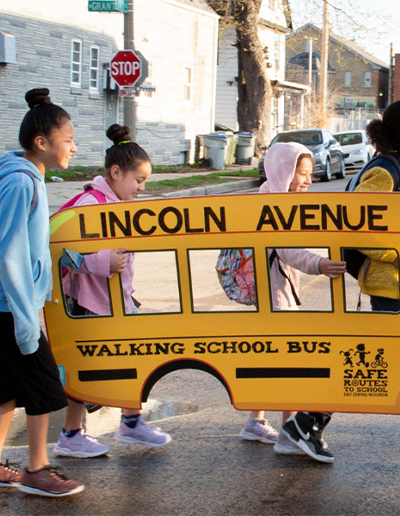
Very simply, Walking School Buses and Rolling Bike Trains are groups of children that walk or bike to school together accompanied by one or more adults. Generally, parents meet at a common location and walk to school, picking up bus “riders” along the way. A Walking School Bus helps introduce the concept of walking and biking to school and help parents understand how easy it can be. They also serve as the education and encouragement foundation for potential future Safe Routes to School grant funding opportunities.
Walk ‘n Rollers Safety Guidelines Brief
A one page PDF to print and distribute.
Your activity can be as simple or as structured as you like. We suggest starting informally with a few friends until your route and timing are down, then promoting the route to others. Be aware that the more structured it is, the more volunteers you’ll need and the more time it will take to organize.
Here are the essentials to start a walking school bus:
- Invite families who live near you to walk or bicycle as a group.
- Select a route, then take a test walk or ride.
- Decide how often the group will travel together – monthly, weekly, daily?
- Start early and be sure to allow a little extra time. It will take a few tries for individuals to get on the same timetable.
- Start walking or bicycling!
If you choose to have multiple meeting points, due to the logistics of your school, identify those points and choose appropriate routes. It helps to select meeting points with easy, safe parking to allow parents who must drive to participate more easily. Also, identify a coordinator for each of your meeting points. Strive to recruit additional volunteers as the program continues and grows.
Once your event becomes established, a few precautions are recommended:
-
- Encourage parents to walk with their children unless you have enough volunteers. In some cases, waivers may be necessary to address liability concerns. Note: Safe Routes to School best practices suggest 1 parent for every 5 children.
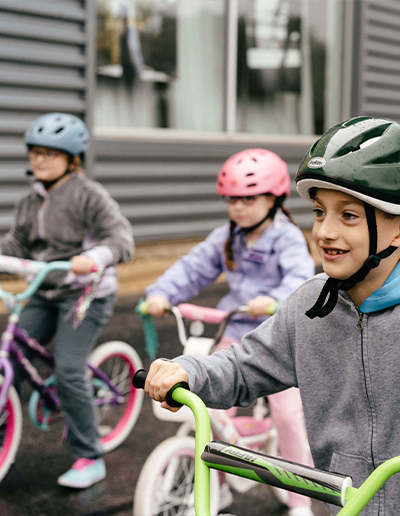
- Be sure that bicycle train participants wear helmets and understand the rules-of-the-road in your area. A brief discussion before starting out is encouraged.
- If this is the first time for some children to ride their bikes to school, we suggest a demonstration on how to lock bikes properly.
- Begin each event with a brief safety talk. This can also be done as parents walk with the children. Points to cover include:
- Always look for cars and make eye contact. Remember that just because it is your turn to cross does not mean that it is safe to cross. Do not trust that cars will obey the rules or that turning cars will see you. Drivers are supposed to obey the rules and watch for people walking. But you cannot count on them to always remember. Note: Parents should lead the children through intersections. If you have a large group, it may be necessary for a volunteer to stay in the intersection until all the children are across.
- Stay on sidewalks or paths. If there are no sidewalks or paths, walk facing traffic as close to the edge of the roadway as possible.
- Watch for cars turning or pulling out of driveways.
- Cross at signalized intersections whenever possible. Discuss pedestrian signals. Obey traffic signs and signals.
- Look left, right and left again. Check behind you and in front of you for turning cars.
- Wait until no traffic is coming and begin crossing. Keep looking for traffic until you have finished crossing.
- Walk, don’t run across the street. Running children can trip and cause injury.
When you are ready to take your event to the next level, we can help. From conducting parent surveys to evaluating interest, to promoting the activity and developing an ongoing encouragement campaign, Walk ‘n Rollers is uniquely qualified to help your school create a successful and personalized event. Contact us for more information.